SOFF X · AIHujjatingizni AI yaratsinSovg'ani oling
Mahsulot tavsifi
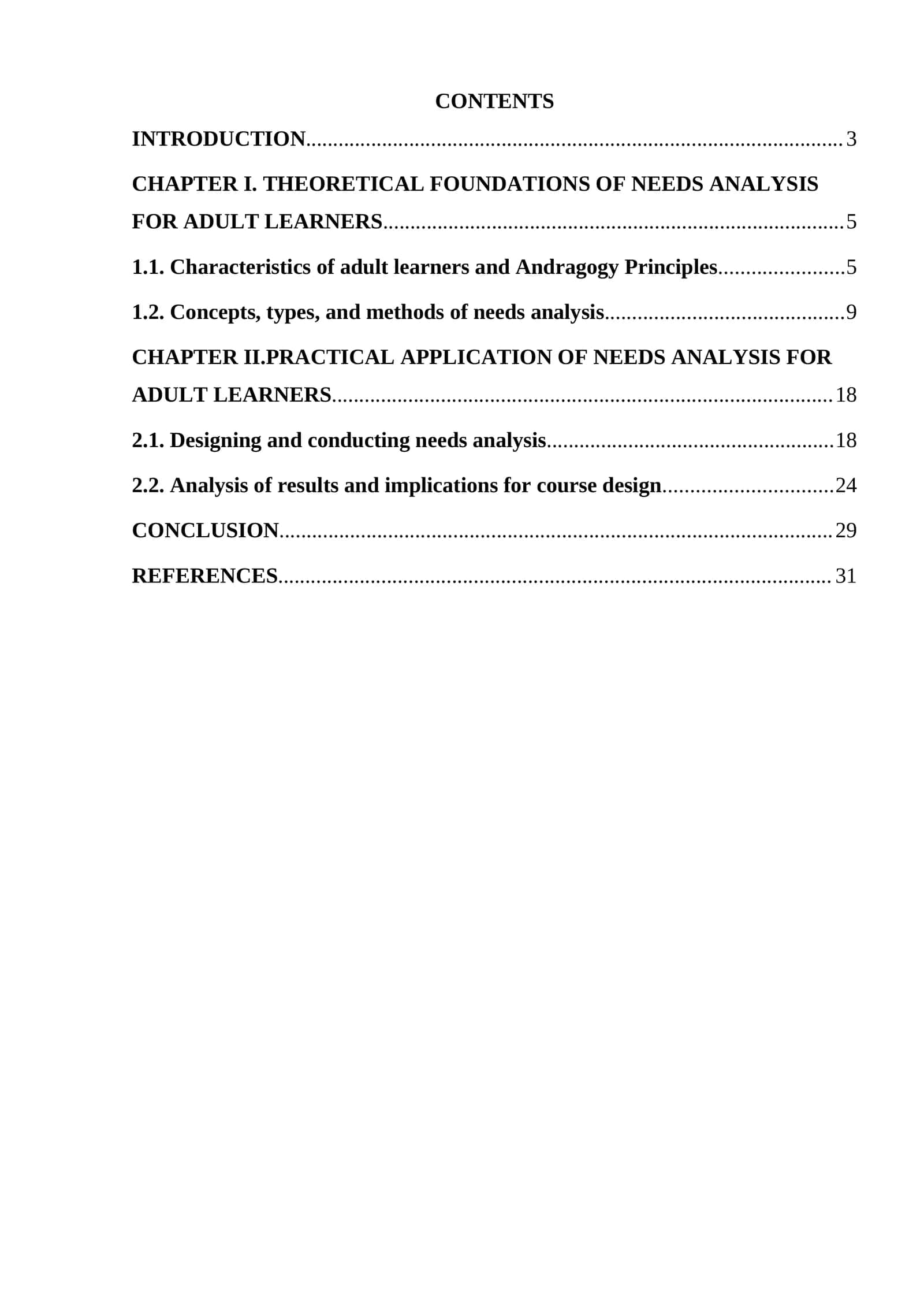
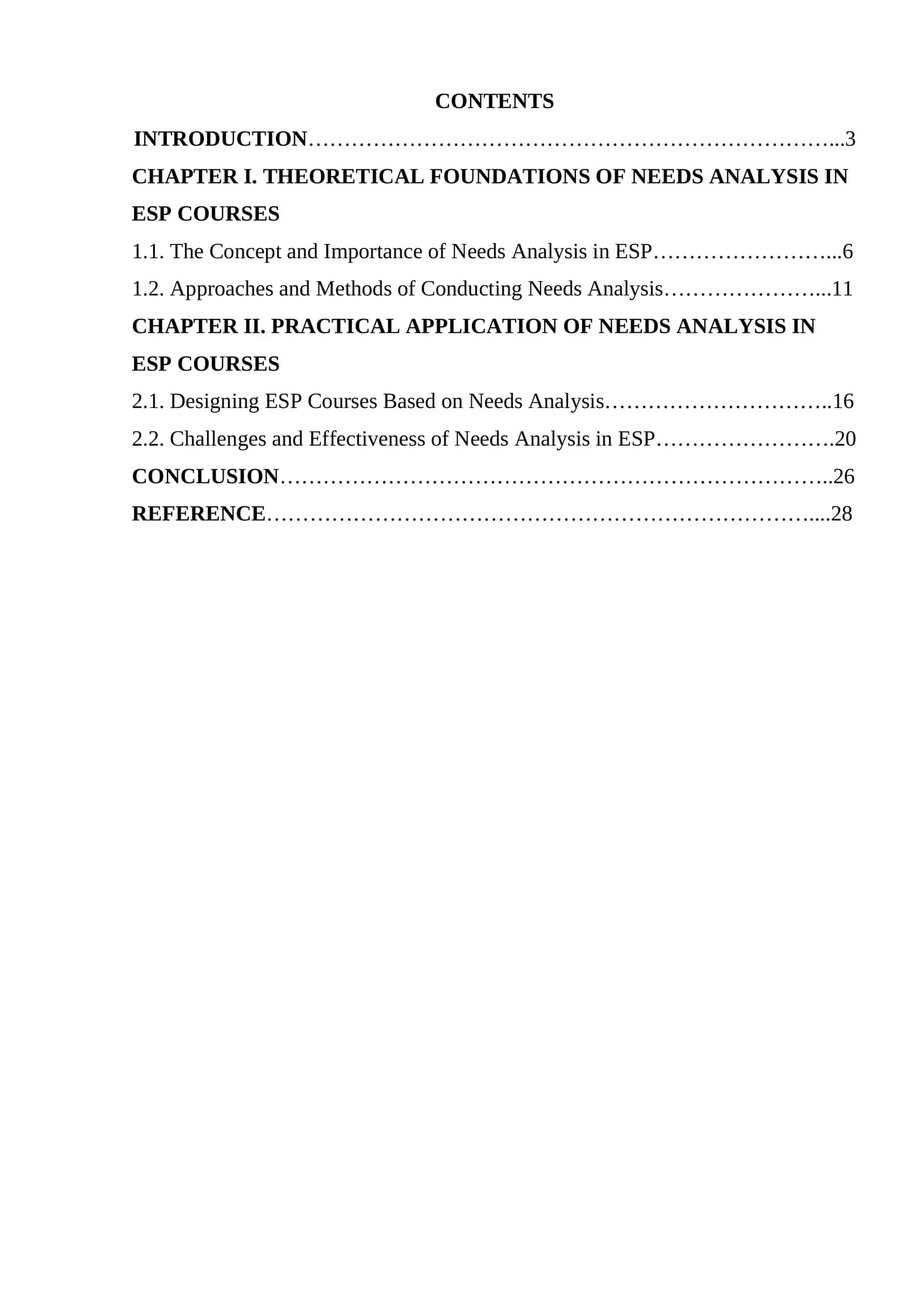
CONTENTS INTRODUCTION ............................................................................................ 2 CHAPTER I CONCEPTUAL FOUNDATIONS OF NEEDS ANALYSIS AND SYLLABUS DESIGN ....................................................................................... 4 1.1. Needs analysis as a basis for language education........................................... 4 1.2. Principles of syllabus design in language teaching......................................... 7 CHAPTER II METHODOLOGICAL FRAMEWORK FOR NEEDS-BASED SYLLABUS DEVELOPMENT ........................................................................ 9 2.1. Techniques and instruments for needs analysis.............................................. 9 2.2. Developing a needs-oriented syllabus......................................................... 15 CHAPTER III PRACTICAL IMPLEMENTATION OF NEEDS ANALYSIS IN SYLLABUS DESIGN ..................................................................................... 18 3.1. Application of needs analysis in educational settings................................... 18 3.2. Designing and evaluating a needs-based syllabus........................................ 22 CONCLUSION .............................................................................................. 26 GLOSSARY ................................................................................................... 29 REFERENCES ............................................................................................... 31 INTRODUCTION In recent decades, the field of language education has undergone significant transformation, moving toward more learner-centered and outcome-oriented approaches. One of the key developments in this shift is the growing emphasis on designing educational content that reflects the actual needs of learners. Needs analysis has emerged as a crucial tool in this process, enabling educators to identify learners’ goals, preferences, and difficulties. By understanding these factors, teachers and curriculum developers can create syllabi that are not only theoretically sound but also practically relevant. As a result, needs analysis plays a vital role in ensuring that language teaching is effective, purposeful, and aligned with real-life communication demands. The modernization of the education system in Uzbekistan has led to increased attention to improving the quality of foreign language teaching and strengthening practical communication skills. Educational policies emphasize the need to adopt innovative methodologies and align teaching practices with international standards. In particular, the President of the Republic of Uzbekistan, Shavkat Mirziyoyev, has stressed the importance of developing foreign language proficiency as a key factor in preparing competitive specialists for the global environment. According to the Presidential Resolution of the Republic of Uzbekistan “On measures to bring the system of learning foreign languages to a qualitatively new level in the Republic of Uzbekistan” , it is necessary to introduce modern teaching approaches and ensure that language education meets learners’ real communicative needs. [1] This highlights the importance of needs analysis as an essential component of effective syllabus planning. The problem of this coursework lies in the limited use of systematic needs analysis in syllabus design within many educational settings. Often, syllabi are developed based on standardized models without fully considering the specific needs and expectations of learners. This can lead to a gap between instructional content and practical language use, reducing the effectiveness of teaching and limiting learners’ communicative competence. The object of the research is the process of syllabus design in language education. The subject of the research is the role of needs analysis in developing effective and learner-centered syllabus. The aim of the coursework is to analyze the significance of needs analysis in syllabus planning and to evaluate its impact on improving language teaching and learning outcomes. The objectives of the research are: to define the concept of needs analysis; to examine its theoretical foundations; to analyze methods and tools used in needs analysis; to explore the process of designing a needs-based syllabus; and to evaluate its practical implementation in educational contexts. The practical significance of this coursework lies in its potential to provide methodological guidance for teachers and curriculum developers in designing more effective and relevant language syllabi. By applying the principles of needs analysis, educators can enhance learners’ motivation, improve communicative competence, and ensure better learning outcomes. The structure of the coursework consists of an introduction, three chapters, a conclusion, a list of references, and a glossary. [1] Resolution of the President of the Republic of Uzbekistan No. PQ-5117, May 6, 2021.
Muallif

- Hujjatlari
- 854
- Sotilgan
- 305